Calculus is a fundamental branch of mathematics that deals with rates of change and accumulation of quantities. One of the key concepts in calculus is the antiderivative of trigonometric functions. Understanding how to find the antiderivatives of trigonometric functions is crucial for solving a wide range of problems in mathematics, physics, engineering, and other fields. This post will delve into the intricacies of finding the antiderivatives of trigonometric functions, providing a comprehensive guide for students and professionals alike.
Understanding Trigonometric Functions
Before diving into the antiderivative of trigonometric functions, it’s essential to have a solid understanding of trigonometric functions themselves. Trigonometric functions are functions of an angle, typically measured in radians or degrees. The most common trigonometric functions are sine (sin), cosine (cos), tangent (tan), cotangent (cot), secant (sec), and cosecant (csc). These functions are periodic and have specific properties that make them useful in various applications.
Basic Antiderivatives of Trigonometric Functions
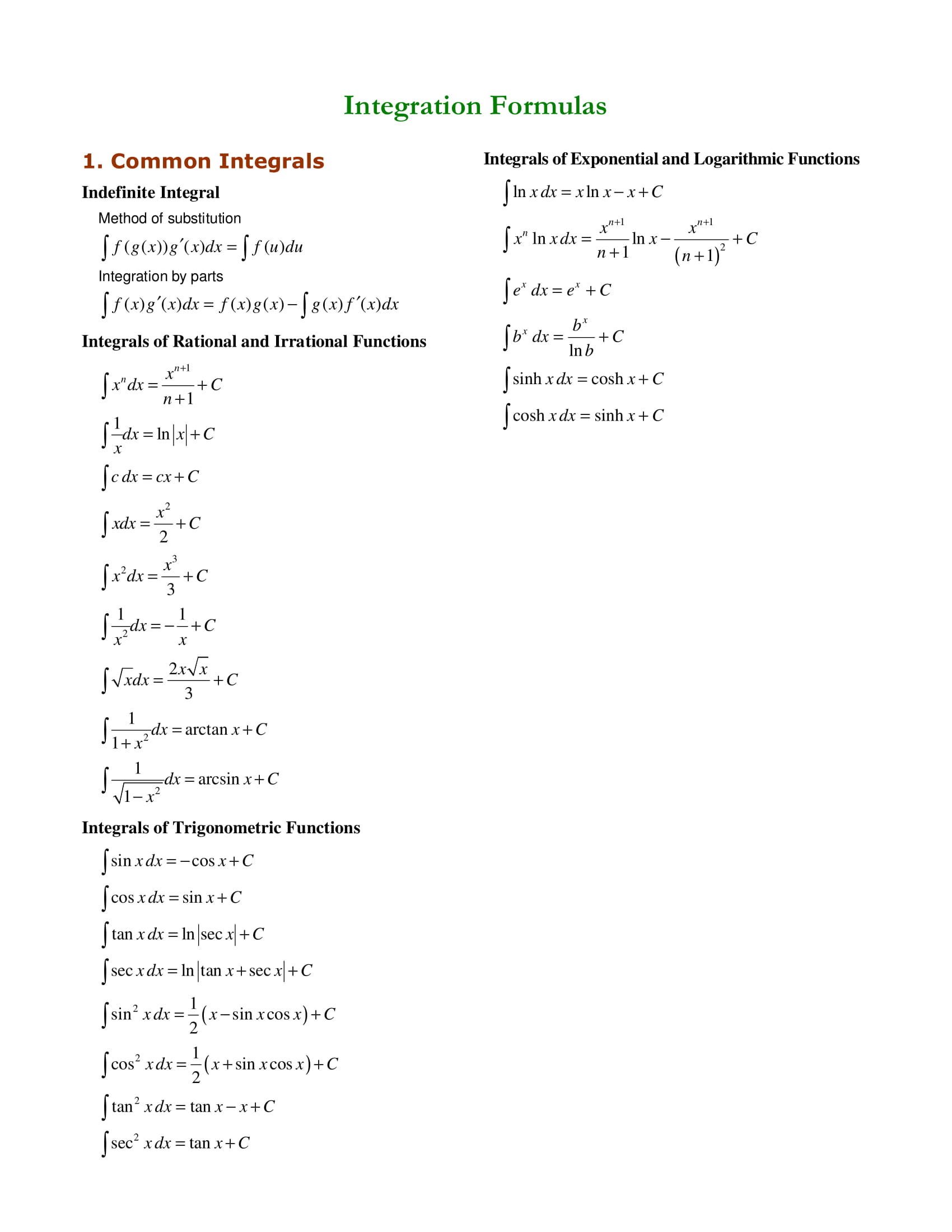
The antiderivative of a function is another function whose derivative is the original function. Finding the antiderivatives of trigonometric functions involves recognizing patterns and applying specific rules. Here are some basic antiderivatives of trigonometric functions:
- Antiderivative of sin(x): The antiderivative of sin(x) is -cos(x).
- Antiderivative of cos(x): The antiderivative of cos(x) is sin(x).
- Antiderivative of tan(x): The antiderivative of tan(x) is -ln|cos(x)|.
- Antiderivative of sec(x): The antiderivative of sec(x) is ln|sec(x) + tan(x)|.
- Antiderivative of csc(x): The antiderivative of csc(x) is -ln|csc(x) + cot(x)|.
- Antiderivative of cot(x): The antiderivative of cot(x) is ln|sin(x)|.
Integrals Involving Trigonometric Functions
When dealing with integrals involving trigonometric functions, it’s important to recognize common patterns and apply appropriate techniques. Here are some examples of integrals involving trigonometric functions and their solutions:
- Integral of sin(ax): The integral of sin(ax) is -(1/a)cos(ax).
- Integral of cos(ax): The integral of cos(ax) is (1/a)sin(ax).
- Integral of sin^2(x): The integral of sin^2(x) is (1/2)x - (1/4)sin(2x).
- Integral of cos^2(x): The integral of cos^2(x) is (1/2)x + (1/4)sin(2x).
- Integral of sin(x)cos(x): The integral of sin(x)cos(x) is (1/2)sin^2(x).
💡 Note: When dealing with integrals involving trigonometric functions, it's often helpful to use trigonometric identities to simplify the expression before integrating.
Advanced Techniques for Finding Antiderivatives
For more complex integrals involving trigonometric functions, advanced techniques such as substitution, integration by parts, and trigonometric identities may be required. Here are some examples of advanced techniques for finding antiderivatives:
- Substitution: Substitution involves replacing a part of the integrand with a new variable to simplify the integral. For example, to find the antiderivative of sin(x^2), we can use the substitution u = x^2.
- Integration by Parts: Integration by parts is a technique that involves integrating the product of two functions. The formula for integration by parts is ∫udv = uv - ∫vdu. For example, to find the antiderivative of xsin(x), we can use integration by parts with u = x and dv = sin(x)dx.
- Trigonometric Identities: Trigonometric identities can be used to simplify integrals involving trigonometric functions. For example, the identity sin^2(x) + cos^2(x) = 1 can be used to simplify integrals involving sin^2(x) and cos^2(x).
Applications of Antiderivatives of Trigonometric Functions
The antiderivative of trigonometric functions has numerous applications in various fields. Here are some examples of how antiderivatives of trigonometric functions are used in real-world scenarios:
- Physics: In physics, antiderivatives of trigonometric functions are used to solve problems involving motion, waves, and oscillations. For example, the position of a particle undergoing simple harmonic motion can be described using the sine or cosine function, and the antiderivative is used to find the velocity and acceleration of the particle.
- Engineering: In engineering, antiderivatives of trigonometric functions are used to analyze signals and systems. For example, in electrical engineering, the Fourier transform is used to analyze periodic signals, and the antiderivative of trigonometric functions is used to find the coefficients of the Fourier series.
- Mathematics: In mathematics, antiderivatives of trigonometric functions are used to solve differential equations and evaluate definite integrals. For example, the antiderivative of trigonometric functions is used to find the area under a curve described by a trigonometric function.
Common Mistakes to Avoid
When finding the antiderivative of trigonometric functions, it’s important to avoid common mistakes that can lead to incorrect solutions. Here are some common mistakes to avoid:
- Forgetting the Constant of Integration: The constant of integration is an essential part of the antiderivative. Forgetting to include the constant of integration can lead to incorrect solutions.
- Incorrect Application of Trigonometric Identities: Incorrect application of trigonometric identities can lead to incorrect solutions. It's important to use trigonometric identities correctly to simplify integrals involving trigonometric functions.
- Incorrect Use of Substitution: Incorrect use of substitution can lead to incorrect solutions. It's important to choose the correct substitution and apply it correctly to simplify the integral.
💡 Note: Always double-check your work to ensure that you have applied the correct techniques and avoided common mistakes.
Practice Problems
To master the antiderivative of trigonometric functions, it’s essential to practice solving problems. Here are some practice problems to help you improve your skills:
- Find the antiderivative of sin(3x).
- Find the antiderivative of cos(2x).
- Find the antiderivative of sin^3(x).
- Find the antiderivative of cos^3(x).
- Find the antiderivative of sin(x)cos(x).
Solving these practice problems will help you gain a deeper understanding of the antiderivative of trigonometric functions and improve your problem-solving skills.
Summary of Antiderivatives of Trigonometric Functions
Here is a summary table of the antiderivatives of common trigonometric functions:
| Function | Antiderivative |
|---|---|
| sin(x) | -cos(x) + C |
| cos(x) | sin(x) + C |
| tan(x) | -ln|cos(x)| + C |
| sec(x) | ln|sec(x) + tan(x)| + C |
| csc(x) | -ln|csc(x) + cot(x)| + C |
| cot(x) | ln|sin(x)| + C |
This table provides a quick reference for the antiderivatives of common trigonometric functions. Memorizing these antiderivatives will help you solve problems more efficiently.
In conclusion, understanding the antiderivative of trigonometric functions is a crucial skill in calculus and has numerous applications in various fields. By mastering the techniques for finding antiderivatives of trigonometric functions, you can solve a wide range of problems and gain a deeper understanding of calculus. Whether you’re a student, a professional, or simply someone interested in mathematics, learning about the antiderivatives of trigonometric functions is a valuable endeavor. With practice and dedication, you can become proficient in finding antiderivatives of trigonometric functions and apply this knowledge to real-world scenarios.
Related Terms:
- derivative and antiderivative rules
- all antiderivative rules
- examples of anti derivative rules
- trig antiderivative rules
- antiderivative table of trig functions
- antiderivatives of trig identities