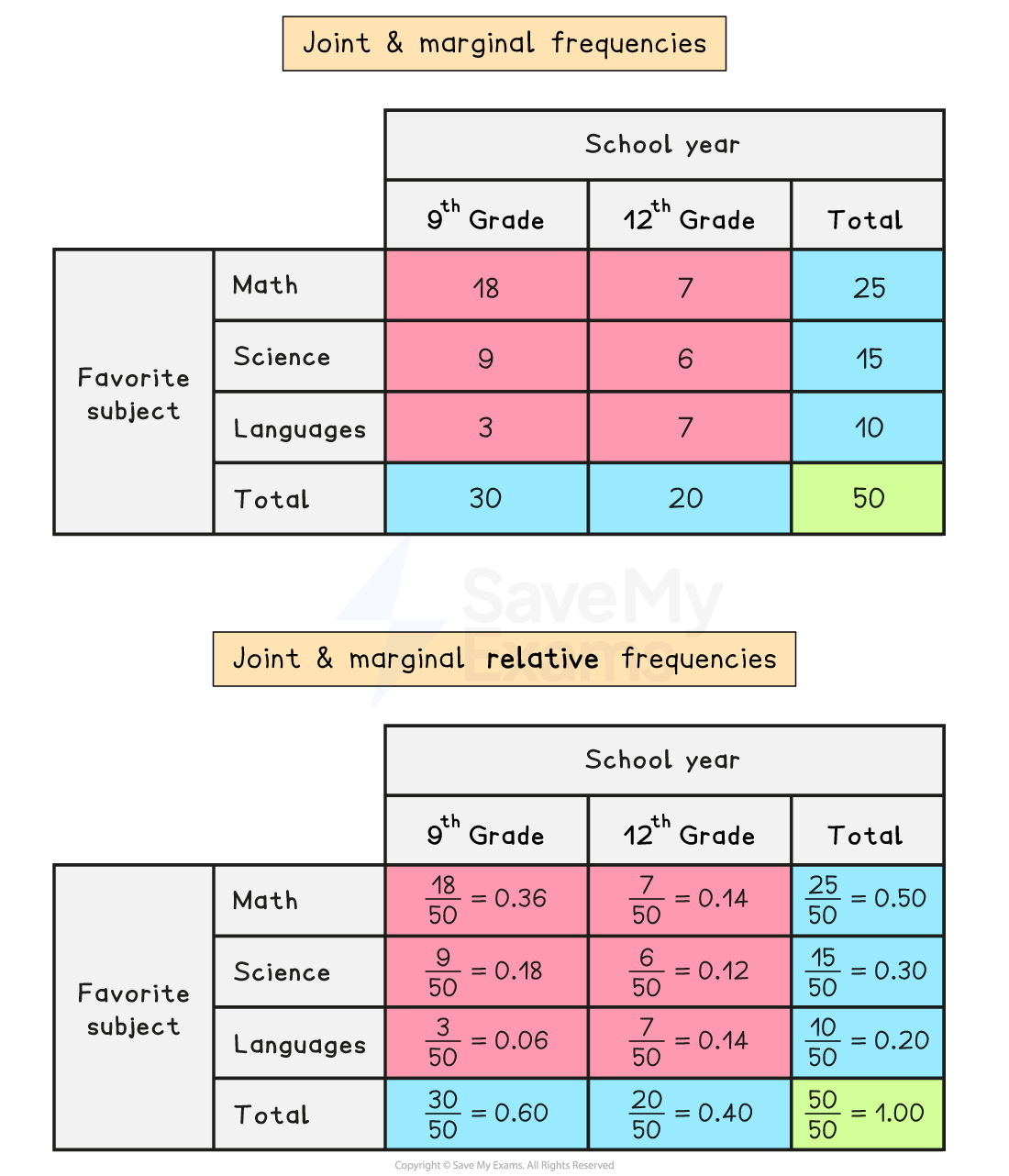
Understanding the concepts of Frequency vs Relative Frequency is crucial in the field of statistics and data analysis. These terms are fundamental for interpreting data and making informed decisions. Frequency refers to the number of times a particular event or value occurs in a dataset. In contrast, relative frequency is the proportion of times an event occurs relative to the total number of observations. This distinction is essential for various statistical analyses and probability calculations.
Understanding Frequency
Frequency is a straightforward concept that counts the number of times a specific event or value appears in a dataset. For example, if you are analyzing the results of a survey where respondents were asked to choose their favorite color, the frequency of each color would be the count of how many times each color was selected.
To illustrate, consider a simple dataset of exam scores:
| Score | Frequency |
|---|---|
| 80 | 5 |
| 85 | 3 |
| 90 | 7 |
| 95 | 2 |
In this table, the frequency of the score 90 is 7, meaning that seven students scored 90 on the exam.
Understanding Relative Frequency
Relative frequency, on the other hand, provides a more normalized view of the data by expressing the frequency as a proportion of the total number of observations. It is calculated by dividing the frequency of an event by the total number of observations. This makes it easier to compare different datasets, even if they have different sizes.
Using the same exam scores dataset, the relative frequency can be calculated as follows:
| Score | Frequency | Relative Frequency |
|---|---|---|
| 80 | 5 | 5/17 |
| 85 | 3 | 3/17 |
| 90 | 7 | 7/17 |
| 95 | 2 | 2/17 |
Here, the relative frequency of the score 90 is 7/17, which simplifies to approximately 0.41. This means that about 41% of the students scored 90 on the exam.
Importance of Frequency vs Relative Frequency
Both frequency and relative frequency play vital roles in data analysis, but they serve different purposes. Frequency is useful for understanding the raw count of occurrences, which can be important for identifying trends and patterns. Relative frequency, however, provides a more comparative perspective, allowing analysts to understand the proportion of each event within the dataset. This is particularly useful when comparing datasets of different sizes.
For example, in market research, frequency might tell you how many customers prefer a particular product, while relative frequency would show you the proportion of customers who prefer that product compared to others. This can help in making strategic decisions about product development and marketing.
Applications of Frequency vs Relative Frequency
The concepts of frequency and relative frequency are applied in various fields, including:
- Market Research: Understanding customer preferences and behaviors.
- Quality Control: Monitoring the frequency of defects in manufacturing processes.
- Healthcare: Analyzing the frequency of diseases or symptoms in patient populations.
- Education: Evaluating the performance of students in exams and identifying areas for improvement.
- Finance: Assessing the frequency of financial transactions and identifying trends.
In each of these fields, the ability to distinguish between frequency and relative frequency is crucial for accurate data interpretation and decision-making.
Calculating Frequency and Relative Frequency
Calculating frequency and relative frequency is a straightforward process. Here are the steps:
- Frequency: Count the number of times each event or value occurs in the dataset.
- Relative Frequency: Divide the frequency of each event by the total number of observations.
For example, if you have a dataset of 50 observations and you want to find the relative frequency of a particular event that occurs 10 times, you would calculate it as follows:
📝 Note: Relative Frequency = Frequency / Total Number of Observations
Relative Frequency = 10 / 50 = 0.2
This means the event occurs 20% of the time.
Interpreting Frequency and Relative Frequency
Interpreting frequency and relative frequency involves understanding the context of the data and what each measure tells you. Frequency provides a clear count of occurrences, which can be useful for identifying the most common events or values. Relative frequency, however, gives a sense of proportion, making it easier to compare different datasets or events within the same dataset.
For instance, if you are analyzing customer feedback and you find that 50 out of 100 customers are satisfied with a product, the frequency of satisfied customers is 50. The relative frequency is 50/100, or 0.5, indicating that 50% of customers are satisfied. This proportion can be compared with other products or services to understand overall customer satisfaction.
Visualizing Frequency and Relative Frequency
Visualizing data is an effective way to understand frequency and relative frequency. Common methods include bar charts, pie charts, and histograms. These visualizations help in quickly grasping the distribution of data and identifying patterns.
For example, a bar chart can show the frequency of different events, while a pie chart can illustrate the relative frequency of each event within the dataset. Histograms are particularly useful for continuous data, showing the distribution of values and their frequencies.
Here is an example of how a bar chart might look for the exam scores dataset:
In this chart, the height of each bar represents the frequency of each score, making it easy to see which scores are most common.
Similarly, a pie chart can show the relative frequency of each score:
In this chart, each slice represents the proportion of students who scored a particular grade, providing a clear visual of the relative frequency of each score.
Histograms are useful for continuous data, such as heights or weights, where the data is divided into bins, and the frequency of values within each bin is plotted. This helps in understanding the distribution of the data and identifying any patterns or outliers.
Frequency Distribution
A frequency distribution is a table or graph that shows the frequency of each value or range of values in a dataset. It provides a summary of the data, making it easier to analyze and interpret. Frequency distributions can be used to identify the most common values, the range of values, and the overall shape of the data distribution.
For example, consider a dataset of student heights in centimeters:
| Height Range (cm) | Frequency |
|---|---|
| 150-155 | 5 |
| 156-160 | 10 |
| 161-165 | 15 |
| 166-170 | 8 |
| 171-175 | 2 |
In this frequency distribution, the height range 161-165 cm has the highest frequency, indicating that the most students fall within this range. This information can be useful for understanding the typical height of students in the dataset.
Relative Frequency Distribution
A relative frequency distribution is similar to a frequency distribution but expresses the frequency as a proportion of the total number of observations. This makes it easier to compare different datasets or events within the same dataset. Relative frequency distributions are particularly useful when the total number of observations varies between datasets.
Using the same student heights dataset, the relative frequency distribution can be calculated as follows:
| Height Range (cm) | Frequency | Relative Frequency |
|---|---|---|
| 150-155 | 5 | 5/40 |
| 156-160 | 10 | 10/40 |
| 161-165 | 15 | 15/40 |
| 166-170 | 8 | 8/40 |
| 171-175 | 2 | 2/40 |
In this relative frequency distribution, the height range 161-165 cm has a relative frequency of 15/40, or 0.375, indicating that 37.5% of the students fall within this range. This proportion can be compared with other datasets to understand the distribution of heights across different groups.
Relative frequency distributions are particularly useful in probability calculations, where the relative frequency of an event is used to estimate the probability of that event occurring. This is based on the law of large numbers, which states that as the number of observations increases, the relative frequency of an event will converge to its true probability.
For example, if you flip a coin 100 times and observe that heads appear 50 times, the relative frequency of heads is 50/100, or 0.5. This suggests that the probability of flipping heads is 0.5, which is consistent with the theoretical probability of a fair coin.
However, it is important to note that relative frequency is an estimate of probability and may not be exact, especially with small sample sizes. As the sample size increases, the relative frequency will converge to the true probability, providing a more accurate estimate.
In summary, understanding the concepts of Frequency vs Relative Frequency is essential for accurate data analysis and interpretation. Frequency provides a raw count of occurrences, while relative frequency offers a proportional view, making it easier to compare different datasets. Both measures are crucial for various applications, including market research, quality control, healthcare, education, and finance. By calculating and interpreting frequency and relative frequency, analysts can gain valuable insights into data patterns and trends, leading to informed decision-making.
Related Terms:
- difference between frequency and relative
- frequency vs relative frequency table
- difference between frequency and relativity
- frequency vs relative frequency histogram
- cumulative frequency vs relative frequency
- relative frequency examples