Magnets and magnetic poles have fascinated scientists and laypeople alike for centuries. These enigmatic objects possess an invisible force that can attract or repel other magnetic materials. Understanding the principles behind magnets and magnetic poles is not only intriguing but also crucial for various technological applications. From simple compasses to complex medical imaging devices, the study of magnets and their poles has revolutionized numerous fields.
Understanding Magnets
Magnets are objects that produce a magnetic field, which is responsible for the force that attracts or repels other magnetic materials. This magnetic field is created by the alignment of tiny magnetic domains within the material. These domains are regions where the magnetic moments of atoms are aligned in the same direction. When these domains are aligned, the material exhibits magnetic properties.
There are different types of magnets, each with unique characteristics:
- Permanent Magnets: These magnets retain their magnetic properties indefinitely. Examples include neodymium magnets and ferrite magnets.
- Temporary Magnets: These magnets only exhibit magnetic properties when placed in a magnetic field. Examples include iron nails and paper clips.
- Electromagnets: These magnets generate a magnetic field when an electric current passes through a coil of wire. They are commonly used in applications requiring a controllable magnetic field.
The Concept of Magnetic Poles
Every magnet has two poles: a north pole and a south pole. These poles are the regions where the magnetic field is most concentrated. The magnetic field lines emerge from the north pole and enter the south pole, creating a closed loop. This phenomenon is fundamental to understanding how magnets interact with each other and with other magnetic materials.
One of the key properties of magnetic poles is that like poles repel each other, while unlike poles attract. This means that the north pole of one magnet will attract the south pole of another magnet, and vice versa. Conversely, the north pole of one magnet will repel the north pole of another magnet, and the same applies to the south poles.
Applications of Magnets and Magnetic Poles
Magnets and their poles have a wide range of applications in various fields. Some of the most notable applications include:
- Compasses: Compasses use the Earth's magnetic field to determine direction. The north pole of the compass needle points towards the Earth's magnetic north pole.
- Electric Motors and Generators: These devices rely on the interaction between electric currents and magnetic fields to convert electrical energy into mechanical energy and vice versa.
- Medical Imaging: Magnetic Resonance Imaging (MRI) machines use powerful magnets to create detailed images of the body's internal structures.
- Data Storage: Hard drives and other magnetic storage devices use magnets to store data. The magnetic poles on the storage medium represent the binary data.
- Industrial Applications: Magnets are used in various industrial processes, such as separating ferrous materials from non-ferrous materials and in magnetic levitation systems.
The Science Behind Magnetic Poles
The science behind magnetic poles involves complex interactions between electric charges and magnetic fields. According to the laws of electromagnetism, a moving electric charge creates a magnetic field. Conversely, a changing magnetic field induces an electric current. This interplay between electric and magnetic fields is described by Maxwell's equations, which form the foundation of classical electromagnetism.
One of the fundamental principles governing magnetic poles is the concept of magnetic dipole moments. A magnetic dipole is a pair of equal and opposite magnetic poles separated by a small distance. The magnetic dipole moment is a measure of the strength and orientation of the magnetic field produced by the dipole. This concept is crucial for understanding the behavior of magnets and their interactions with other magnetic materials.
Another important concept is magnetic flux. Magnetic flux is a measure of the amount of magnetic field passing through a given area. It is quantified by the product of the magnetic field strength and the area perpendicular to the field. The unit of magnetic flux is the weber (Wb). Understanding magnetic flux is essential for designing and analyzing magnetic circuits and devices.
Magnetic Materials
Magnetic materials are those that can be magnetized and exhibit magnetic properties. These materials can be classified into several categories based on their magnetic behavior:
| Type of Material | Description |
|---|---|
| Ferromagnetic Materials | These materials exhibit strong magnetic properties and can retain magnetization even in the absence of an external magnetic field. Examples include iron, nickel, and cobalt. |
| Paramagnetic Materials | These materials are weakly attracted by magnetic fields but do not retain magnetization. Examples include aluminum and platinum. |
| Diamagnetic Materials | These materials are weakly repelled by magnetic fields. Examples include copper and gold. |
| Ferromagnetic Materials | These materials exhibit strong magnetic properties and can retain magnetization even in the absence of an external magnetic field. Examples include iron, nickel, and cobalt. |
Ferromagnetic materials are particularly important in the study of magnets and magnetic poles. These materials have a high magnetic permeability, which means they can concentrate magnetic field lines and enhance the magnetic field strength. This property makes them ideal for use in magnetic cores, transformers, and other magnetic devices.
💡 Note: The behavior of magnetic materials can be influenced by factors such as temperature and mechanical stress. For example, heating a ferromagnetic material above its Curie temperature can cause it to lose its magnetic properties.
Magnetic Fields and Their Properties
Magnetic fields are invisible regions around a magnet where the magnetic force can be detected. These fields are characterized by several properties:
- Direction: Magnetic field lines emerge from the north pole and enter the south pole, creating a closed loop.
- Strength: The strength of the magnetic field is measured in units of tesla (T) or gauss (G). One tesla is equal to 10,000 gauss.
- Interaction: Magnetic fields can interact with other magnetic fields and with electric currents, producing forces and inducing currents.
One of the key properties of magnetic fields is their ability to exert forces on moving electric charges. This phenomenon is described by the Lorentz force law, which states that the force on a charged particle moving in a magnetic field is proportional to the charge, the velocity of the particle, and the strength of the magnetic field. This interaction is fundamental to the operation of many electrical and electronic devices.
Magnetic fields also exhibit the property of superposition, which means that the total magnetic field at a point is the vector sum of the individual magnetic fields at that point. This property is crucial for analyzing complex magnetic systems and designing magnetic devices.
Another important property of magnetic fields is their ability to store energy. The energy stored in a magnetic field is proportional to the square of the magnetic field strength and the volume of the region containing the field. This property is utilized in various applications, such as inductors and magnetic energy storage systems.
💡 Note: Magnetic fields can be visualized using iron filings or a compass. When iron filings are sprinkled around a magnet, they align with the magnetic field lines, creating a visible pattern. Similarly, a compass needle will align with the magnetic field, pointing towards the north pole.
Magnetic Poles and Earth's Magnetism
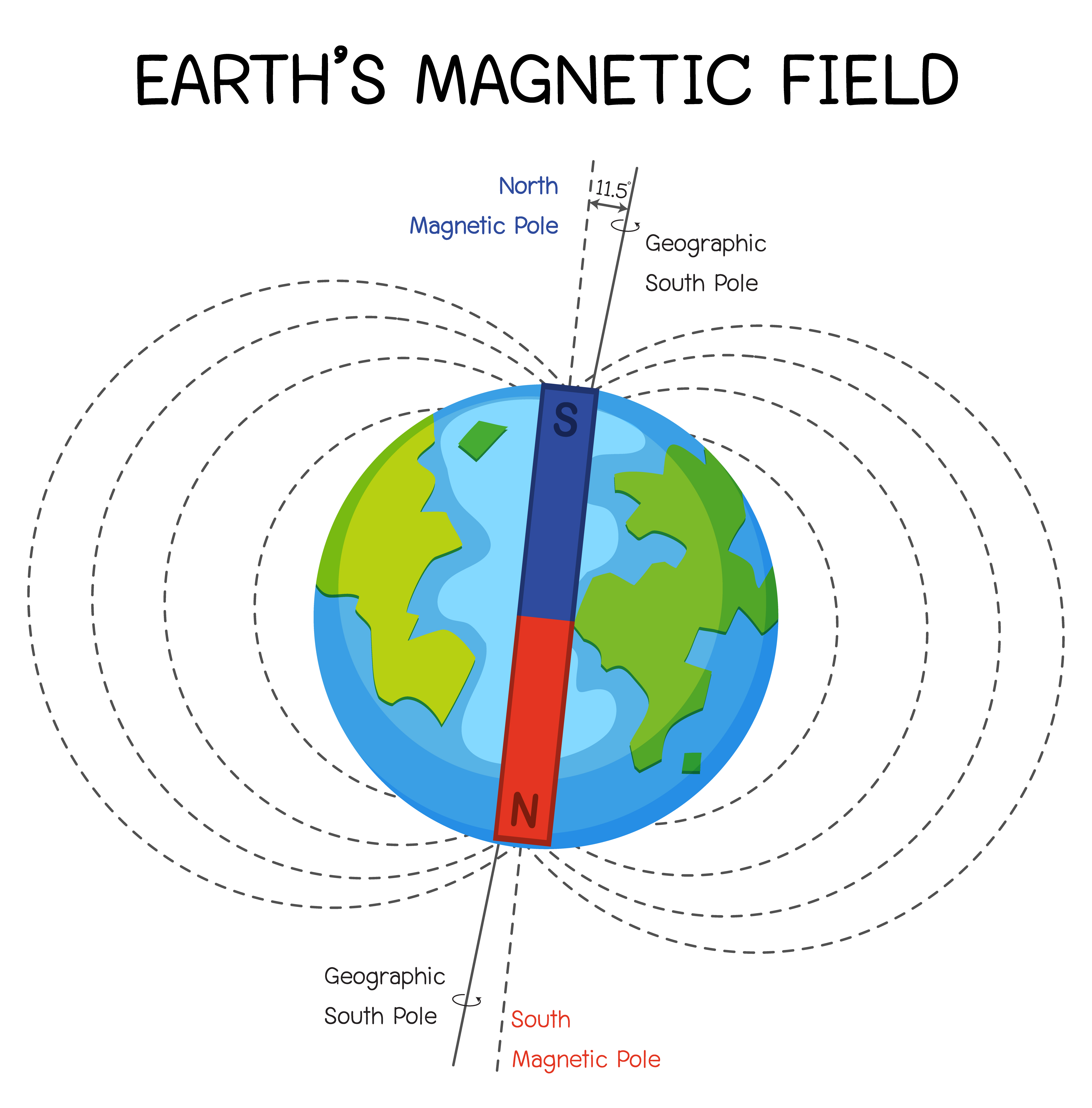
Earth itself is a giant magnet, with a magnetic field that extends from the core to the outer atmosphere. This magnetic field is generated by the motion of molten iron in the Earth's outer core, a process known as the dynamo effect. The Earth's magnetic field has two poles: the magnetic north pole and the magnetic south pole. These poles are not fixed and can shift over time, a phenomenon known as magnetic pole reversal.
The Earth's magnetic field plays a crucial role in protecting the planet from harmful solar radiation. The magnetic field deflects charged particles from the sun, creating a region known as the magnetosphere. This protective shield helps to maintain the Earth's atmosphere and supports life on the planet.
The Earth's magnetic field also has practical applications. Compasses rely on the Earth's magnetic field to determine direction, making them essential tools for navigation. Additionally, the study of the Earth's magnetic field provides valuable insights into the planet's internal structure and dynamics.
One of the fascinating aspects of the Earth's magnetic field is its interaction with the solar wind. The solar wind is a stream of charged particles emitted by the sun, which interacts with the Earth's magnetic field to create auroras. These beautiful displays of light are visible in the polar regions and are a result of the interaction between the solar wind and the Earth's magnetic field.
Another important aspect of the Earth's magnetic field is its role in the migration of animals. Many animals, including birds and sea turtles, use the Earth's magnetic field for navigation during their long migrations. This ability is thought to be mediated by specialized sensory organs that detect the magnetic field.
💡 Note: The Earth's magnetic field is not perfectly aligned with the Earth's axis of rotation. The magnetic north pole is located in the Arctic region, while the magnetic south pole is located in the Antarctic region. The angle between the magnetic axis and the Earth's axis of rotation is known as the magnetic inclination.
Magnetic Poles and Technology
Magnets and magnetic poles play a crucial role in modern technology. From simple devices like compasses to complex systems like magnetic resonance imaging (MRI) machines, the principles of magnetism are essential for their operation. Understanding how magnets and magnetic poles work is key to advancing these technologies and developing new applications.
One of the most significant applications of magnets and magnetic poles is in the field of energy. Electric motors and generators rely on the interaction between electric currents and magnetic fields to convert electrical energy into mechanical energy and vice versa. These devices are used in a wide range of applications, from electric vehicles to wind turbines.
Another important application is in data storage. Hard drives and other magnetic storage devices use magnets to store data. The magnetic poles on the storage medium represent the binary data, which can be read and written using a magnetic head. This technology has revolutionized the way we store and access information.
Magnets and magnetic poles are also used in medical imaging. Magnetic resonance imaging (MRI) machines use powerful magnets to create detailed images of the body's internal structures. This non-invasive imaging technique is essential for diagnosing and monitoring various medical conditions.
In industrial applications, magnets are used for separating ferrous materials from non-ferrous materials. This process is crucial in recycling and waste management, where it is important to separate different types of materials for recycling. Magnets are also used in magnetic levitation systems, which allow objects to float above a magnetic surface without physical contact.
One of the emerging applications of magnets and magnetic poles is in the field of renewable energy. Magnetic levitation wind turbines use magnets to levitate the rotor, reducing friction and increasing efficiency. This technology has the potential to revolutionize the wind energy industry by making wind turbines more efficient and cost-effective.
Another exciting application is in the field of magnetic refrigeration. Magnetic refrigeration uses the magnetocaloric effect, where a material's temperature changes in response to a changing magnetic field. This technology has the potential to be more energy-efficient and environmentally friendly than traditional refrigeration methods.
💡 Note: The study of magnets and magnetic poles is an active area of research. Scientists are continually discovering new materials and phenomena that could lead to breakthroughs in technology and medicine.
In conclusion, magnets and magnetic poles are fundamental to our understanding of the natural world and have numerous practical applications. From the Earth’s magnetic field to the latest technological innovations, the study of magnets and their poles continues to captivate scientists and engineers alike. As our knowledge of magnetism grows, so too will our ability to harness its power for the benefit of humanity.
Related Terms:
- like poles repel each other
- why do magnets have poles
- poles of a magnet definition
- what are the magnetic poles
- magnetic poles and fields
- magnets and their poles