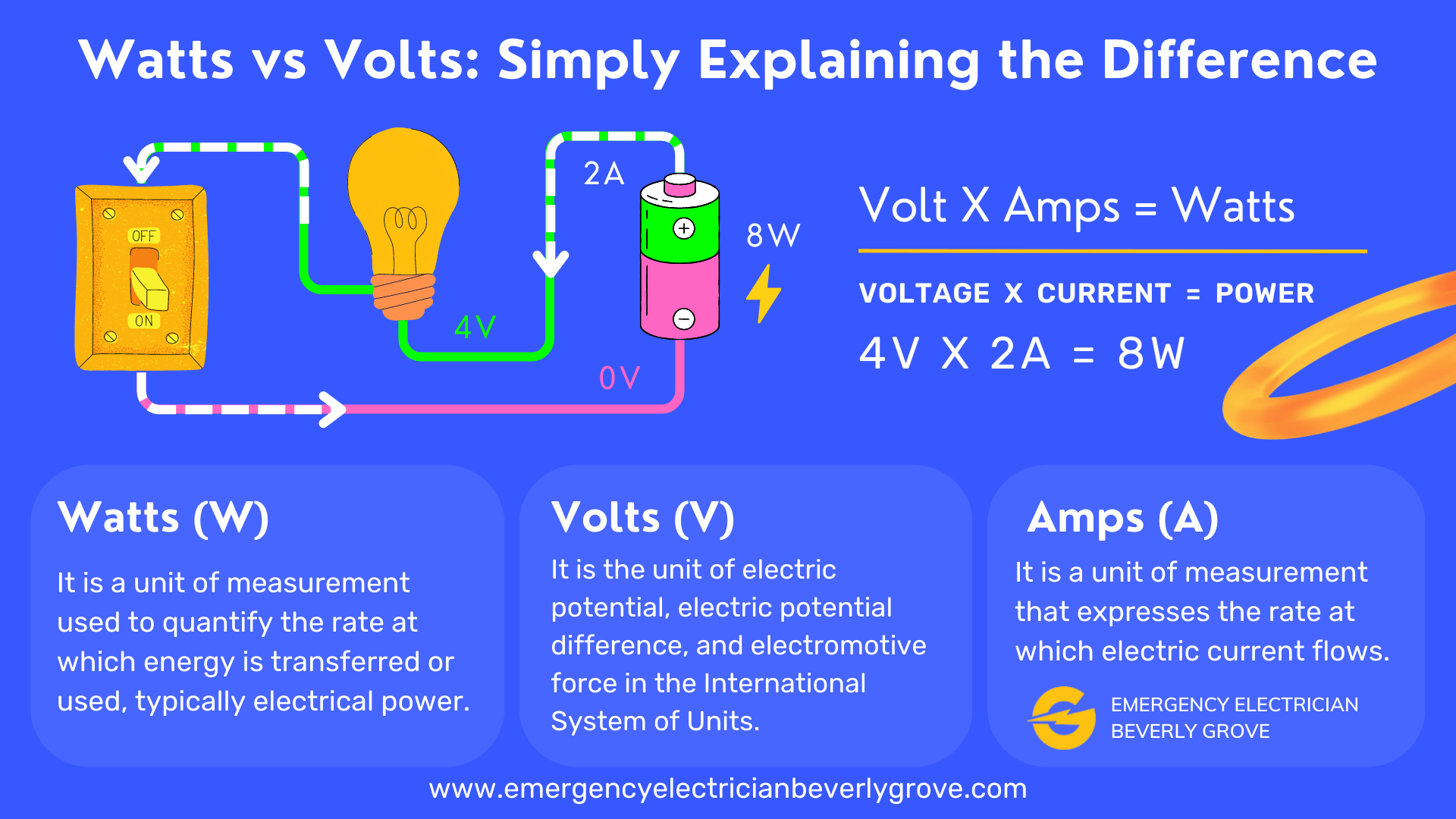
Understanding the fundamentals of electricity is crucial for anyone working with electrical systems, whether you're a hobbyist, a professional electrician, or simply curious about how your home's wiring works. The concepts of Watts, Volts, and Amps are the cornerstone of electrical theory. These terms are often used interchangeably, but they represent distinct measurements that are essential for calculating power, voltage, and current in electrical circuits.
What are Watts, Volts, and Amps?
To grasp the basics of electricity, it's important to understand what each of these terms means:
- Watts: This is a unit of power, named after the Scottish engineer James Watt. It measures the rate at which electrical energy is transferred or converted. In simpler terms, it tells you how much work an electrical device can do.
- Volts: This is a unit of electrical potential difference, or voltage. It measures the force that drives the electrical current through a circuit. Think of it as the "pressure" in an electrical system.
- Amps: This is a unit of electrical current, short for amperes. It measures the flow of electrical charge through a circuit. It's like the "flow rate" of electricity.
The Relationship Between Watts, Volts, and Amps
The relationship between Watts, Volts, and Amps is defined by Ohm's Law and the Power Law. These laws are fundamental to understanding how electrical systems work:
- Ohm's Law: This law states that the current (I) flowing through a conductor between two points is directly proportional to the voltage (V) across the two points. Mathematically, it is expressed as V = IR, where R is the resistance.
- Power Law: This law states that the power (P) in watts is equal to the voltage (V) multiplied by the current (I). Mathematically, it is expressed as P = VI.
By combining these laws, you can derive the following formulas:
- P = VI (Power in watts is equal to voltage in volts times current in amps)
- V = IR (Voltage in volts is equal to current in amps times resistance in ohms)
- I = P/V (Current in amps is equal to power in watts divided by voltage in volts)
- R = V/I (Resistance in ohms is equal to voltage in volts divided by current in amps)
Calculating Watts, Volts, and Amps
Let's go through some examples to illustrate how to calculate Watts, Volts, and Amps using these formulas.
Example 1: Calculating Power (Watts)
Suppose you have a circuit with a voltage of 12 volts and a current of 3 amps. To find the power in watts, you use the formula P = VI:
P = 12V * 3A = 36W
So, the power is 36 watts.
Example 2: Calculating Voltage (Volts)
If you have a circuit with a current of 5 amps and a resistance of 10 ohms, you can find the voltage using Ohm's Law, V = IR:
V = 5A * 10Ω = 50V
So, the voltage is 50 volts.
Example 3: Calculating Current (Amps)
If you have a circuit with a power of 60 watts and a voltage of 12 volts, you can find the current using the formula I = P/V:
I = 60W / 12V = 5A
So, the current is 5 amps.
Example 4: Calculating Resistance (Ohms)
If you have a circuit with a voltage of 24 volts and a current of 2 amps, you can find the resistance using the formula R = V/I:
R = 24V / 2A = 12Ω
So, the resistance is 12 ohms.
💡 Note: Always ensure that the units of measurement are consistent when performing calculations. For example, if you are using volts and amps, make sure the power is in watts.
Practical Applications of Watts, Volts, and Amps
Understanding Watts, Volts, and Amps is not just theoretical; it has practical applications in everyday life. Here are a few examples:
- Home Electrical Systems: Knowing how to calculate Watts, Volts, and Amps can help you determine the appropriate wiring and circuit breakers for your home. For example, if you have a 120-volt circuit and you want to run a 1000-watt appliance, you can calculate the current required as follows:
I = P/V = 1000W / 120V = 8.33A
So, you would need a circuit breaker rated for at least 8.33 amps to safely run the appliance.
- Automotive Electrical Systems: In cars, understanding Watts, Volts, and Amps is crucial for maintaining the electrical system. For instance, if your car battery is rated at 12 volts and you have a 50-watt headlight, you can calculate the current draw as follows:
I = P/V = 50W / 12V = 4.17A
So, the headlight draws approximately 4.17 amps.
- Electronic Devices: Many electronic devices, such as smartphones and laptops, have specifications listed in Watts, Volts, and Amps. Understanding these specifications can help you choose the right power adapter or charger.
Safety Considerations
Working with electrical systems involves certain risks, so it's important to follow safety guidelines:
- Always Turn Off Power: Before working on any electrical circuit, make sure to turn off the power at the source.
- Use Proper Tools: Use insulated tools designed for electrical work to minimize the risk of shock.
- Check for Live Wires: Use a non-contact voltage tester to check for live wires before touching any part of the circuit.
- Follow Local Codes: Ensure that your electrical work complies with local building codes and regulations.
By understanding Watts, Volts, and Amps, you can ensure that your electrical systems are safe and efficient.
🛑 Note: Never attempt electrical work if you are not trained or experienced. Always consult a professional electrician for complex tasks.
Common Mistakes to Avoid
When working with electrical systems, it's easy to make mistakes that can lead to inefficiencies or even hazards. Here are some common mistakes to avoid:
- Incorrect Calculations: Double-check your calculations to ensure that you are using the correct formulas and units.
- Overloading Circuits: Be mindful of the current draw of your devices and ensure that your circuits are not overloaded.
- Ignoring Resistance: Resistance is a crucial factor in electrical circuits. Ignoring it can lead to incorrect calculations and potential hazards.
- Using Incompatible Components: Ensure that all components in your circuit are compatible and rated for the voltage and current you are using.
By avoiding these mistakes, you can ensure that your electrical systems are safe and reliable.
Conclusion
Understanding Watts, Volts, and Amps is essential for anyone working with electrical systems. These concepts form the foundation of electrical theory and are crucial for calculating power, voltage, and current in circuits. By mastering the formulas and practical applications, you can ensure that your electrical systems are safe, efficient, and reliable. Whether you’re a hobbyist, a professional, or simply curious about electricity, knowing these fundamentals will serve you well in your electrical endeavors.
Related Terms:
- watts and volts difference
- amps volts watts chart
- amps x volts equal watts
- difference between volts and amps
- volts over amps
- volt amp to watt calculator